The culture behind the show
Gaúcho traditions of Rio Grande do Sul: dress, chimarrão, churrasco and the CTGs
Who the gaúcho is, what the pilcha and the prenda dress are, how chimarrão is drunk, where churrasco comes from and why tradition centres keep the dances alive.
Pick my gaúcho night ↗Quick answer
The gaúcho is the horseman of the southern plains, and in Brazil the word also means anyone from Rio Grande do Sul. Gaúcho tradition lives on in the state through its dress, the pilcha; its drink, chimarrão; its barbecue, churrasco; and the Centros de Tradições Gaúchas that teach the dances. The Gramado Gaucho Night gathers all four into one evening.
Gaúcho tradition in six words
| What it is | Source | |
|---|---|---|
| Gaúcho | A skilled horseman of the plains; in Brazil, also anyone from Rio Grande do Sul | Wikipedia |
| Pilcha | The traditional dress of gaúcho culture, for men and women | Portuguese Wikipedia |
| Prenda | The woman of the tradition, and her long dress, created from 1948 | Portuguese Wikipedia |
| Chimarrão | Mate sipped from a cuia through a bomba | Portuguese Wikipedia |
| Churrasco | Barbecue that originated in southern Brazil | Wikipedia |
| CTG | A non-profit tradition centre; the first opened in Porto Alegre in 1948 | Portuguese Wikipedia |
A horseman, and a whole state
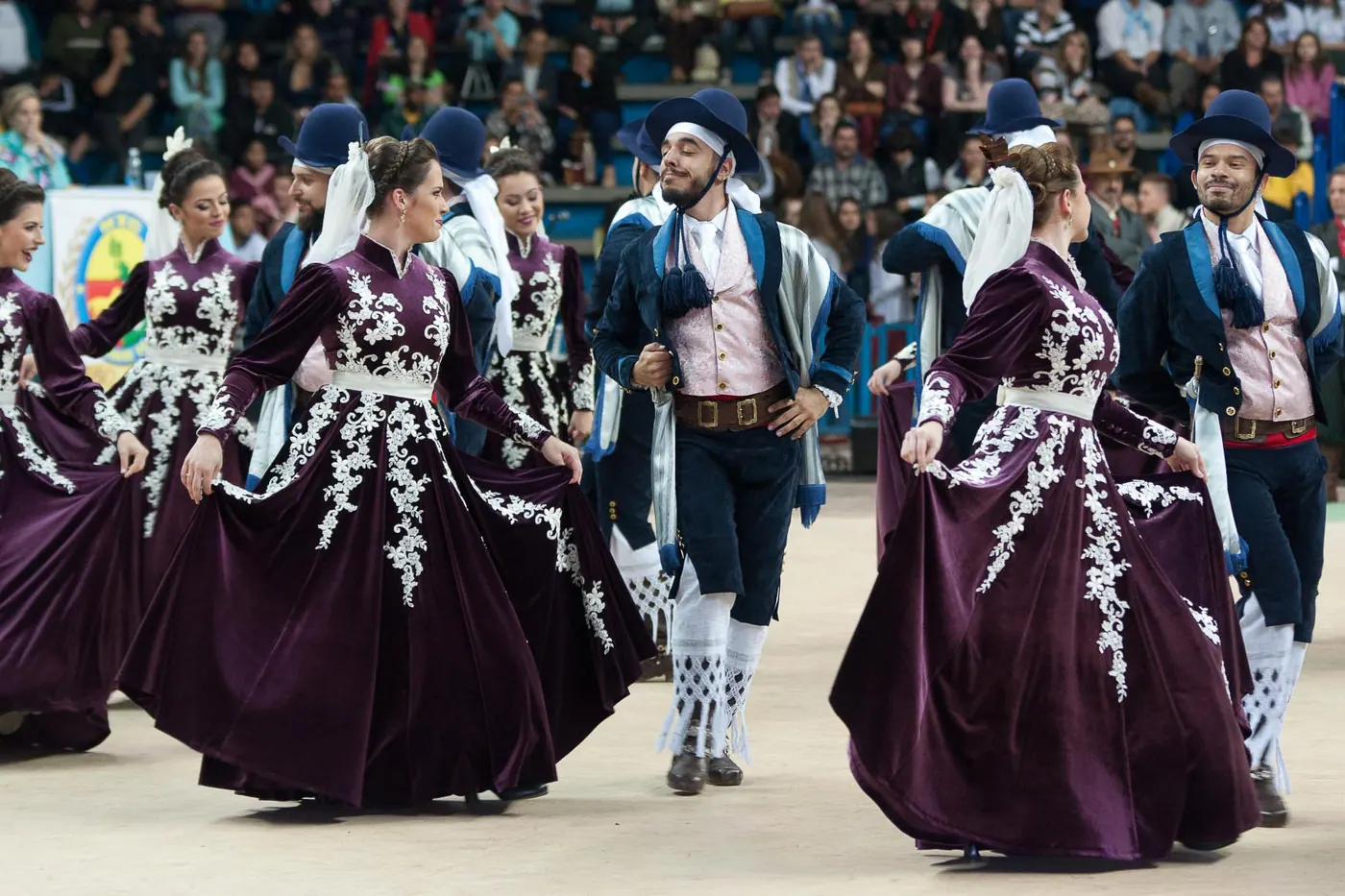
English Wikipedia calls the gaucho a horseman of great skill, known for courage and a streak of unruliness, and names him a folk figure above all in Argentina and Uruguay, though also in Paraguay, southern Brazil, southern Bolivia and southern Chile. In its historical sense, the article says, quoting the dictionary of the Spanish language, the gaucho was a migratory horseman, adept at cattle work, who lived in Rio Grande do Sul as well as Argentina and Uruguay in the 18th and 19th centuries. Portuguese gives the word a second, everyday meaning. In Brazil, gaúcho has come to mean anyone who is a citizen of Rio Grande do Sul, city dweller or not. So when Brazilians talk about gaúcho food or gaúcho music, they mean the culture of the whole southern state, and that is the culture a gaúcho night puts on stage.
Where the word comes from
Nobody knows for certain. Wikipedia counts more than fifty proposed origins and quotes the etymologist Joan Corominas, who thought most of them not worth discussing. One theory it sets out at length, from the Uruguayan sociolinguist José Pedro Rona, places the word's birth on the frontier between Spanish and Portuguese, from northern Uruguay to the Brazilian borderlands, and argues that the Portuguese form gaúcho probably came before the Spanish gaucho. Whatever its source, the accent on the u is how Rio Grande do Sul still writes it.
The pilcha: what the dancers wear
Pilcha is the traditional dress of gaúcho culture, worn by men and women of all ages, Portuguese Wikipedia explains, and in Rio Grande do Sul, Santa Catarina and Paraná the law treats it as a dress of honour, fit even for formal public ceremonies. For the peão, the man, the article lists bombacha trousers, a shirt in a neutral colour, a lenço knotted at the neck, usually white, red or green, leather boots in black or brown, a waistcoat, a guaiaca belt and a hat in one of the traditional gaúcho shapes rather than a cowboy hat. In the photographs on this page, taken at a tradition-centre dance showcase in Porto Alegre, you can pick out several of these pieces.
Small details with meaning
Some rules of the pilcha carry meaning of their own. Portuguese Wikipedia calls the lenço a fundamental piece, usually white, red or green or in a small check, notes that floral prints are not recommended for it, and says black is worn only in mourning. The guaiaca, the wide belt, should include a pocket for a watch, and the hat must keep the crown shapes of gaúcho tradition rather than a cowboy style. Spotting these details is part of the pleasure of watching a folklore group.
The prenda and her dress
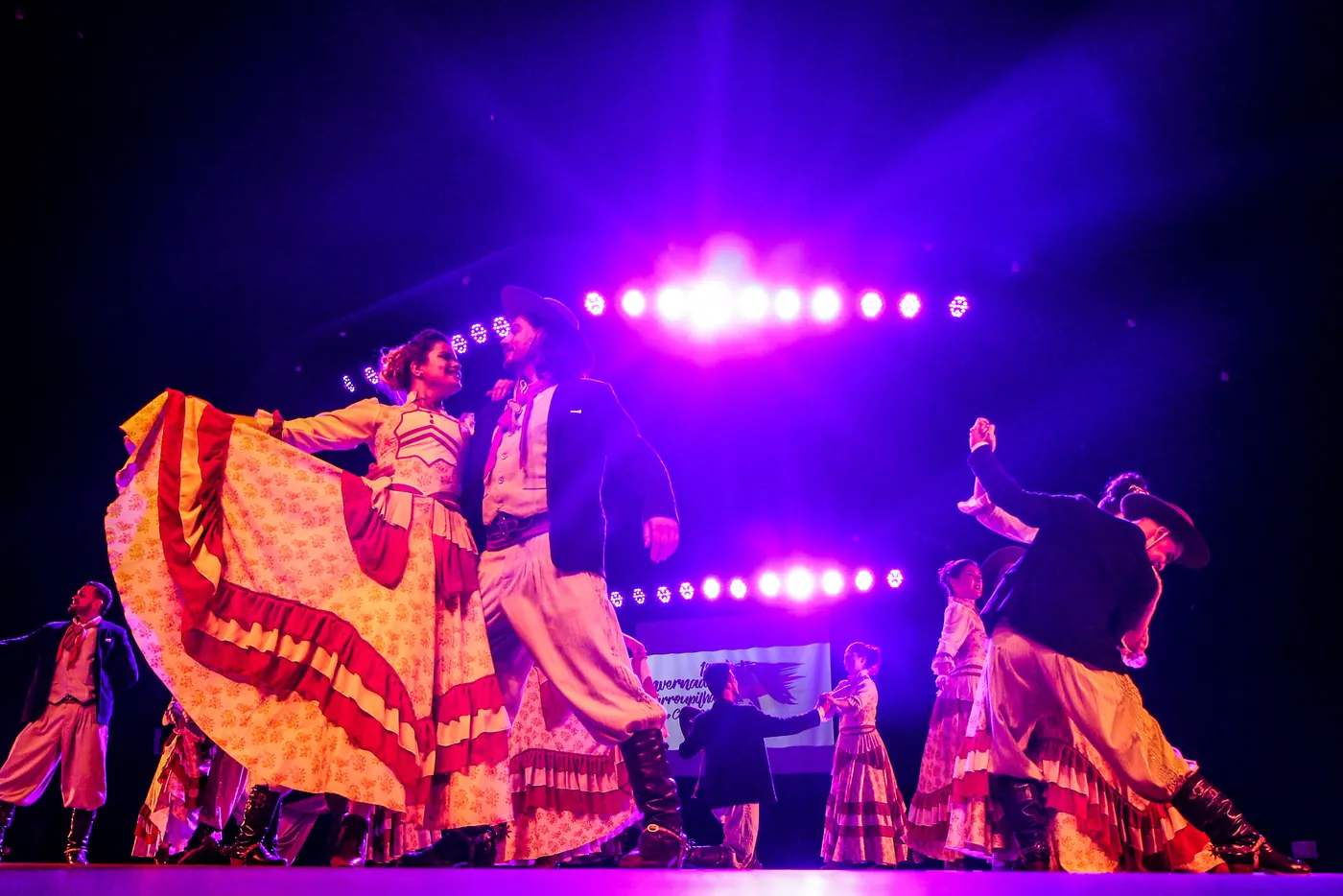
The woman of the tradition is the prenda. Portuguese Wikipedia says the prenda dress was created from 1948, when 35 CTG was founded, by the Movimento Tradicionalista Gaúcho, to represent the gaúcho woman in harmony with the men's clothes, drawing on elements inherited from Azorean and Indigenous peoples. The guidance it summarises asks for a long dress in one piece with the shoulders covered, sleeves that are plain or softly gathered, and fabrics that are plain or delicately printed, with lace, embroidery or appliqué allowed as long as it is not overdone. Hair is worn half up or braided, with ribbons or small flowers. On stage, the wide skirts are what catch the light when a couple turns.
Chimarrão, the gourd of the south
Chimarrão is mate prepared the way southern Brazil drinks it: ground yerba mate, Ilex paraguariensis, steeped in hot water in a cuia and sipped through a bomba, a metal straw that also works as a filter. Portuguese Wikipedia puts the water at around 70 degrees Celsius and calls the drink characteristic of the Southern Cone, a legacy of Indigenous peoples including the Kaingang and the Guaraní. English Wikipedia adds that in Brazil traditionally prepared mate is called chimarrão and that drinking it is a common social practice. The Portuguese article lists Rio Grande do Sul, Santa Catarina and Paraná among the Brazilian states where the habit runs deep. At the gaúcho night it opens the evening, served on arrival with the house starters.
Churrasco, the fire at the centre
English Wikipedia's article on churrasco says Brazilian barbecue originated in the south of the country. It is cooked on a churrasqueira, often with no grill at all, only skewers held above the embers, or on large metal or wooden skewers stuck into the ground beside the fire; charcoal is usual, and wood is used especially in Rio Grande do Sul. A home with its own churrasqueira, the article adds, is a main selling point for property in southern Brazil. In restaurants, the espeto corrido or rodízio style sends waiters round with skewers to slice meat at the table, a format especially popular in Rio Grande do Sul, Paraná and Santa Catarina. At the gaúcho night, dinner is listed simply as a Brazilian barbecue.
The tradition centres
The dances you see at a gaúcho night are kept alive by the Centros de Tradições Gaúchas, or CTGs. Portuguese Wikipedia describes a CTG as a non-profit civil society that spreads the traditions and folklore of gaúcho culture as recorded by folklorists the movement recognises, through dance, churrasco and sport. The first CTG founded in Brazil was 35 CTG, in Porto Alegre, on 24 April 1948, started by a group of eight that included Barbosa Lessa and Paixão Cortes; an older society, the União Gaúcha João Simões Lopes Neto, was founded in Pelotas in 1899. The article counts about 1,300 CTGs across Brazil and 16 abroad. Garfo e Bombacha's rooms, the Viator listing says, resemble a typical CTG.
The movement behind them
The Movimento Tradicionalista Gaúcho, founded in Rio Grande do Sul on 27 November 1947, brings the tradition centres together, Portuguese Wikipedia says, with more than 1,400 affiliated organisations in the state, grouped into 30 traditionalist regions. With the CTGs it runs prenda and peão contests, talks and cavalcades, and the Semana Farroupilha, which celebrates 20 September, the Day of the Gaúcho. September is when the state's tradition is most on show; the dance showcase in the photographs on this page was held in Porto Alegre that month in 2018.
Rio Grande do Sul and its neighbours
Rio Grande do Sul is Brazil's southernmost state, bordered by Uruguay and Argentina, and English Wikipedia says it shares a gaucho culture with both. Its capital is Porto Alegre, the city where the first CTG opened. The article also notes that German and Italian immigration shaped the state in large waves during the 19th century, after the Jesuits and the Azorean settlers. That mix is why an evening in Gramado can feel European in its streets and gaúcho at its table.
Gramado's place in it
Gramado is not on the open plains where the gaúcho rode. It sits in the Serra Gaúcha, the highlands of the north-east of the state, where most people have German or Italian ancestry and the towns show it in their buildings and food, English Wikipedia notes. Portuguese Wikipedia adds an older layer: before the immigrants, drovers of Azorean descent, the tropeiros, crossed the area and rested their cattle there, and one account ties the town's name to the soft grass, the gramado, they found at the top of the hills. A gaúcho night in Gramado brings the culture of the whole state up the hill to where visitors stay.
Where else to see the dances
Beyond evenings staged for visitors, the tradition centres hold their own festivals and showcases through the year, and September brings the busiest calendar. The caption of the main photograph in this guide, on Wikimedia Commons, says the 2018 showcase at the Auditório Araújo Vianna in Porto Alegre gathered ten CTG dance groups to mark the month dedicated to the state's traditions. If your trip falls in September, ask locally which centres are dancing in public.
Watching with a local eye
Watch the clothes as well as the steps: the colour of a lenço, the shape of a hat, the cut of the bombacha, the sweep of a prenda's skirt. Listen to how the music and the dancing answer each other, because the show comes with live music. Take the chimarrão when it is offered, even if you only manage a sip. And if you are in Rio Grande do Sul in September, look out for Semana Farroupilha events, when the tradition centres bring their dancers out in public.
From tradition to the dinner table
Put the pieces together and the Gramado Gaucho Night reads as a short course in the culture: chimarrão as you walk in, churrasco for dinner, a room that looks like a tradition centre, and a folklore group in front of you once the plates are cleared. It is staged for visitors, with a bus from your hotel and a guide, but every item on the programme has deep roots in Rio Grande do Sul.
Frequently asked questions
What does gaúcho mean in Brazil?
A horseman of the southern plains and, in everyday Brazilian Portuguese, anyone from Rio Grande do Sul.
What is a prenda?
The woman of gaúcho tradition, and the long dress she wears; Portuguese Wikipedia dates the dress to 1948.
Sources
- Gaucho, English Wikipedia
- Churrasco, English Wikipedia
- Mate (drink), English Wikipedia
- Serra Gaúcha, English Wikipedia
- Pilcha, Portuguese Wikipedia
- Centro de Tradições Gaúchas, Portuguese Wikipedia
- Movimento Tradicionalista Gaúcho, Portuguese Wikipedia
- Chimarrão, Portuguese Wikipedia
- Gramado, Portuguese Wikipedia
- Viator listing 2484P124, Gramado Gaucho Night: Brazilian Barbecue Dinner and Show, checked via Viator's partner API and live page, 29 November 2026